
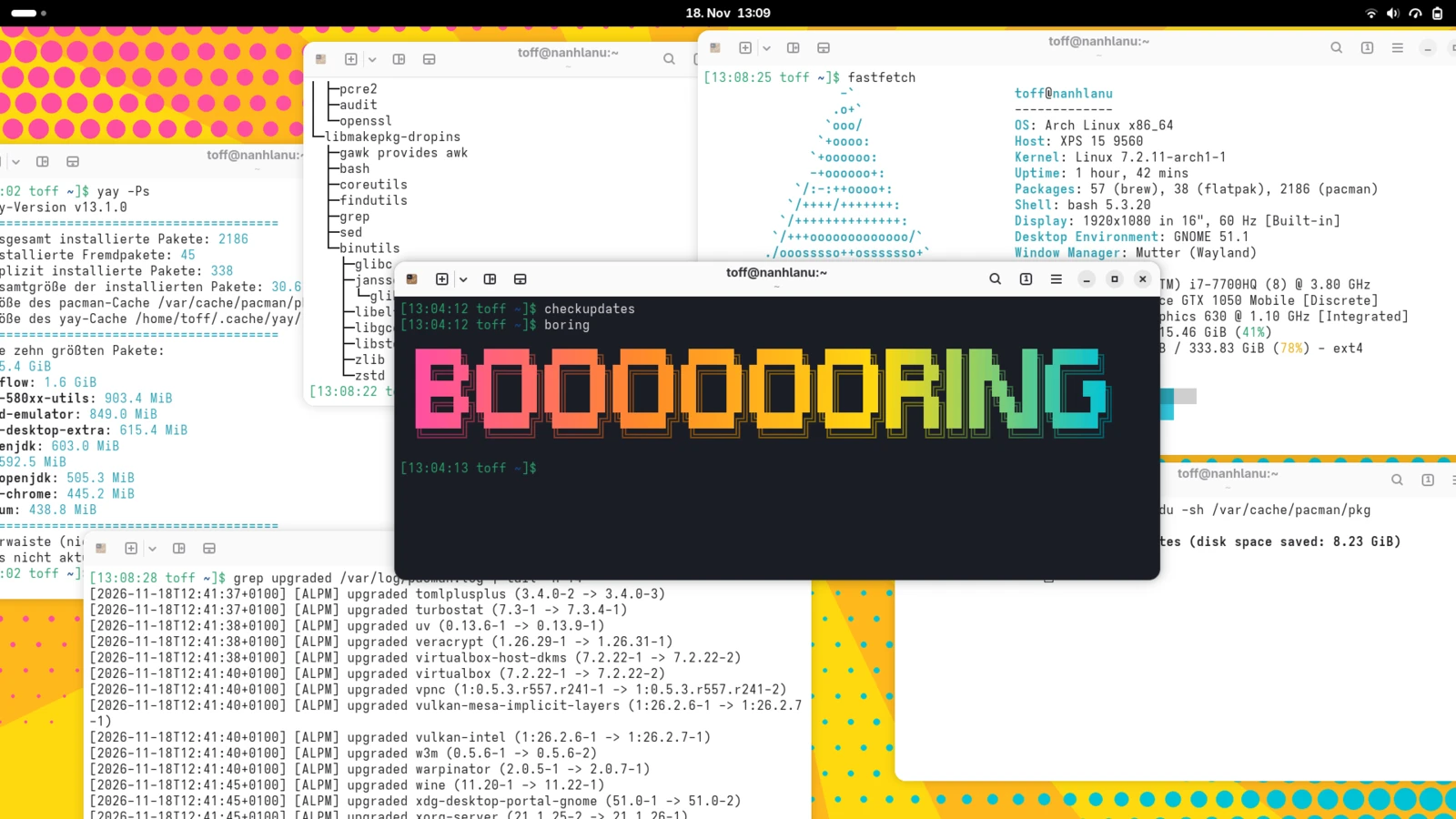
Twice a year, the Linux world declares a state of emergency. Ubuntu gets a new animal with an adjective, Fedora follows on the same beat, and roughly every two years Debian gets its turn in the spotlight, too. Then the machine starts rolling: press release, reviews on every portal, videos with a wide-open mouth in the thumbnail and, of course, upgrade guides including rescue tips for afterwards.
And Arch Linux? Stands next to it with nothing to show. No codename, no version number, no release date. New software lands in the repositories package by package as soon as it’s ready, not when the marketing calendar says so. Once a month there’s a new installation image, and the matching press release would be short: “Arch Linux 2026.11.01 released. What’s new: all packages are up to date.” Not even the most diligent YouTuber can squeeze ten minutes out of that.
Headlines only come with trouble
Arch really only makes the news when something is on fire or money is flowing. In August 2025, a DDoS attack took down the website, forum and AUR for more than a week, and in June 2026 over 400 malicious packages showed up in the AUR. In 2024, Arch made the headlines because Valve helped fund its build service and package signing. The rest of the year: radio silence.
The rest is taken care of by the meme of the eternally broken Arch. Admit in a forum that you use Arch, and you get pity plus the advice to sweep up the debris after every update. Often from people whose last contact with Arch was the installation page in the wiki. That the official repositories were never affected by the AUR incidents spoils the punchline. The truth is, unfortunately, much duller.
My way to Arch – and then nothing
I switched to Arch in June 2013. After more than seven years with Ubuntu, a current GNOME had become plain unusable there despite extra PPAs, while on Arch the GNOME Shell purred like a kitten. With the zeal of the freshly converted, I started the series Mein Weg zu Arch (My way to Arch, in German) here on the blog: kickoff, part 1 and part 2, all within three days.
There never was a part 3; the cliffhanger has been waiting thirteen years for its resolution. I simply ran out of material: nobody writes a sequel about a system that just works. In 2015, seven articles with Arch in the title still appeared here, six in 2016, one in 2017. Then four years of silence, although admittedly the blog itself was taking a break, too. Very Arch of it.
The last real breakage on record in the blog dates back to April 2015. After the update to GNOME 3.16 (in German), the desktop only greeted me with “Oh no! Something has gone wrong.”, and a virtual console came to the rescue. I promptly turned it into a warning article with “Aufgepasst” (heads up) in the headline. It remained the last of its kind; even GNOME extensions have behaved for years.
Eight years, 696 updates, zero headlines
My oldest running installation lives on my old Dell XPS 15, set up on July 11, 2018. According to its log, pacman has updated the system 696 times since then and replaced 57,080 packages; the kernel moved from 4.17 to 7.2, the GNOME Shell from 3.28 to 51. I have reinstalled the thing not… one… single… time. And it hasn’t been my main machine for ages, so nobody even expects it to be stable.
The beginning of the log now reads like a museum exhibit. The first line still shows the call with which pacstrap installed the base system from the live system into /mnt back then, including glibc 2.27:
head -8 /var/log/pacman.log
[2018-07-11 20:09] [PACMAN] Running 'pacman -r /mnt -Sy --cachedir=/mnt/var/cache/pacman/pkg --noconfirm base'
[2018-07-11 20:09] [PACMAN] synchronizing package lists
[2018-07-11 20:12] [ALPM] transaction started
[2018-07-11 20:12] [ALPM] installed linux-api-headers (4.16.1-1)
[2018-07-11 20:12] [ALPM] installed tzdata (2018e-1)
[2018-07-11 20:12] [ALPM] installed iana-etc (20180221-1)
[2018-07-11 20:12] [ALPM] installed filesystem (2018.1-2)
[2018-07-11 20:12] [ALPM] installed glibc (2.27-3)
[...]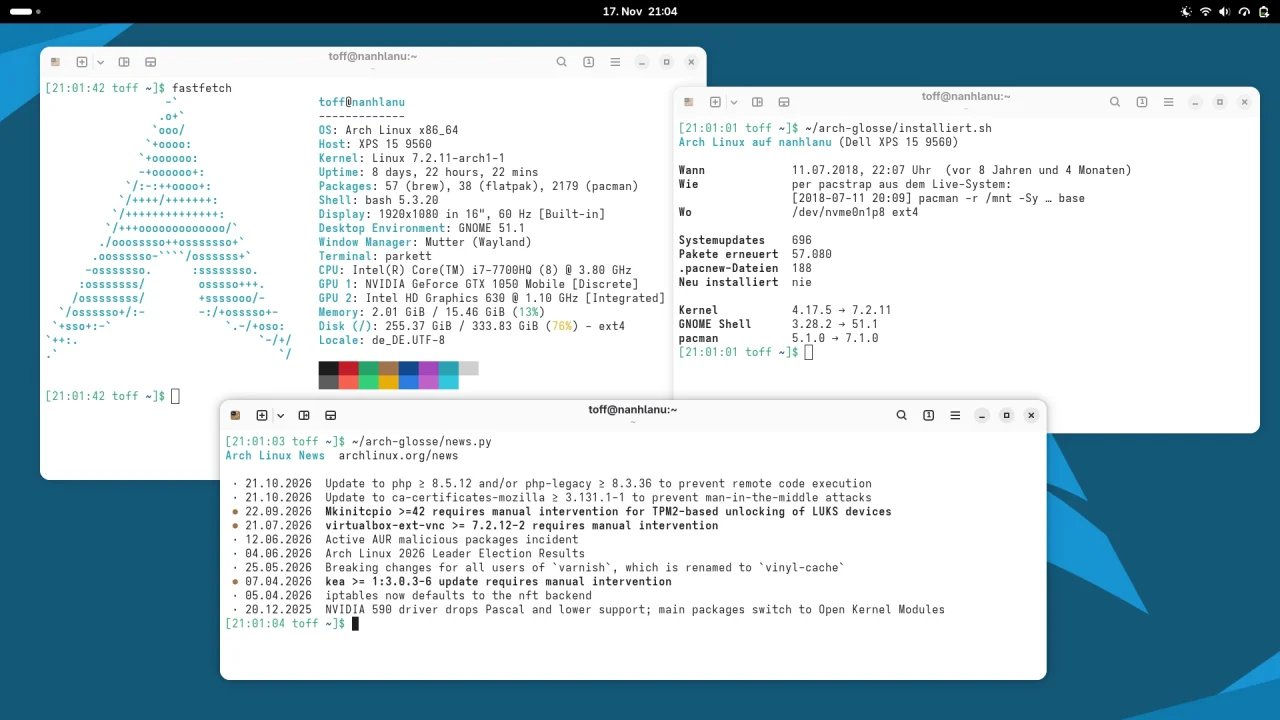
And the dreaded follow-up work? 188 .pacnew files in eight years, meaning configuration files you should compare against the new template. Plus the occasional look at the Arch news. Since January 2025, nine of its posts called for manual intervention, and three of them mattered for a typical desktop. Three manual fixes in almost two years: still not enough for a part 3 of the series.
Everyone else’s release party, on the other hand, ends with a hangover, and it’s called a dist upgrade. Disable third-party repositories, pray the PPAs keep up, rescue your configuration and, when in doubt, reinstall after all. That’s no accusation against Ubuntu, Fedora or Debian; fixed releases have their merits. On Arch, the hangover simply doesn’t happen. An update is an update is an update.
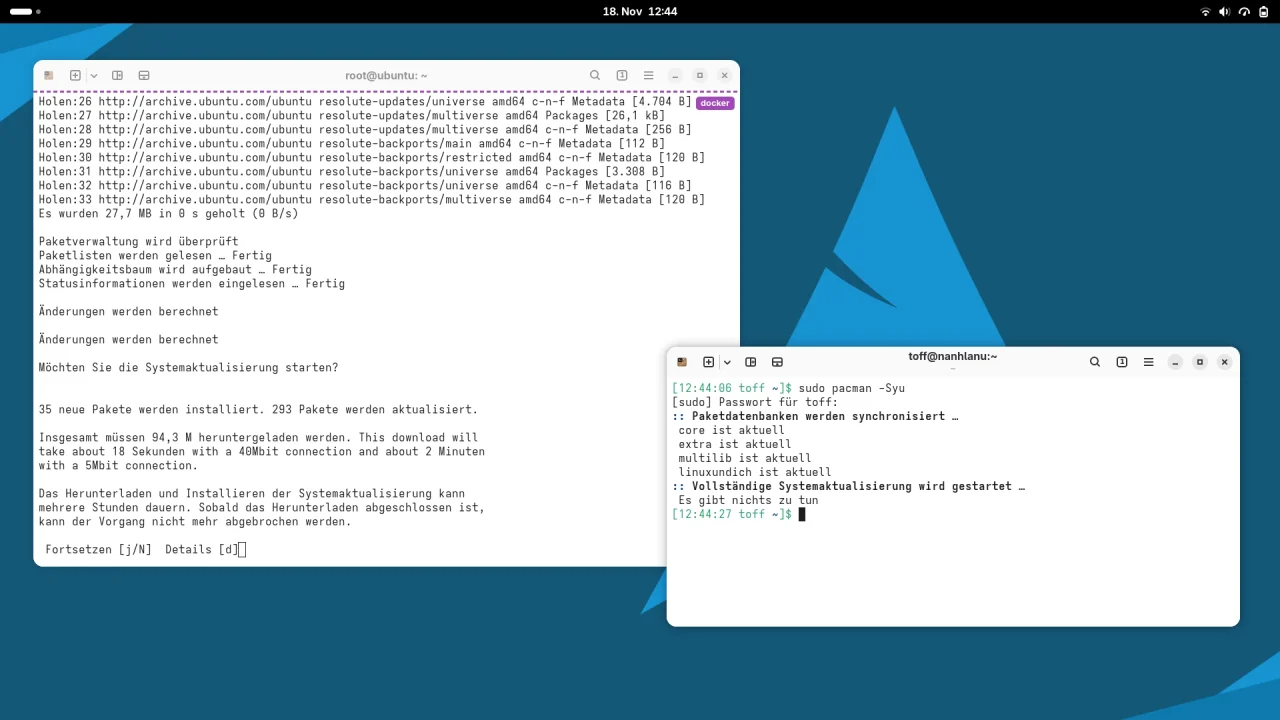
The last time I set up Arch from scratch was in July 2026 on my main machine. Nothing was broken; I just wanted full-disk encryption, and that’s easiest to set up on a fresh installation. So Arch doesn’t force a reinstall on you, you have to bring that on yourself. After all, a new version that would do it for you never comes.
Boring is a compliment
For journalists, Arch Linux is an imposition: no dates, no lists of new features, no upgrade drama, not even a codename for the headline. I know what I’m talking about: this text needs a chart and four screenshots to prove that nothing happens. As a user, that’s exactly what I want, an operating system that stays invisible. Yes, Arch is boring. You can hardly say anything better about an operating system.
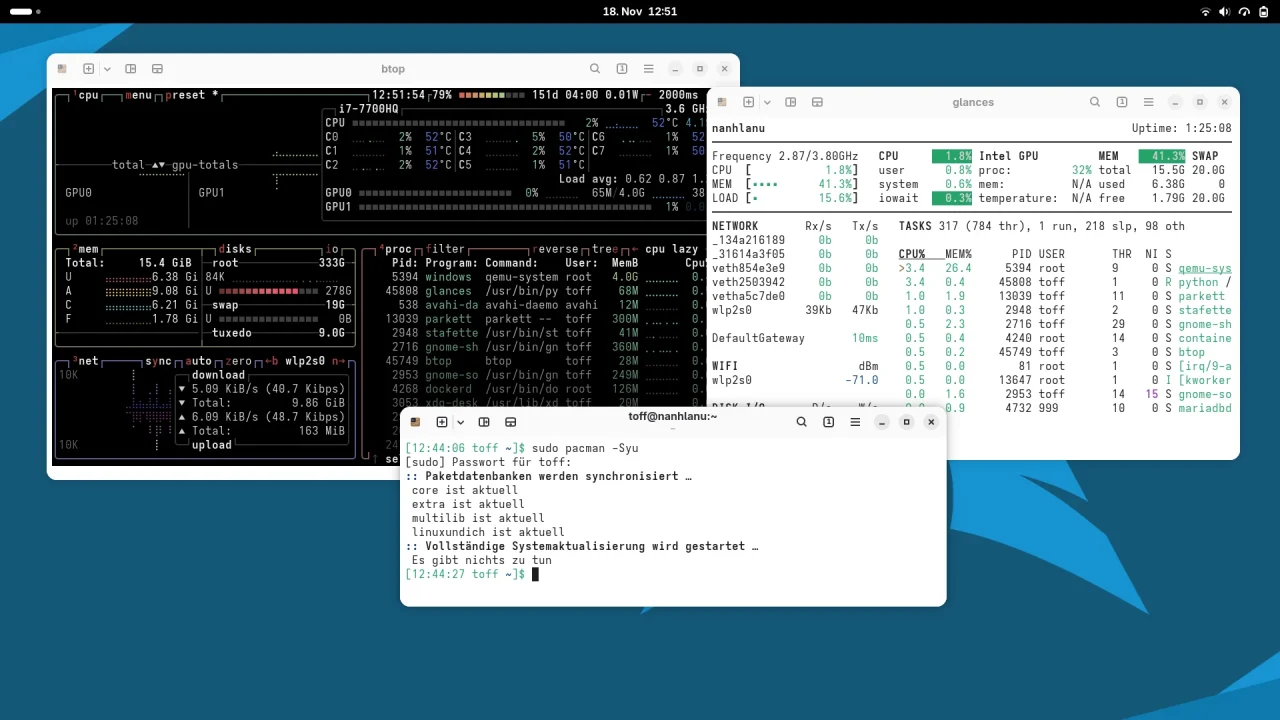
How about you? How old is your oldest installation, whether Arch or another distribution, and when did you last really have to step in by hand? And if you have an Arch horror story ready: the comments are open, I urgently need material for part 3.

Leave a Reply