
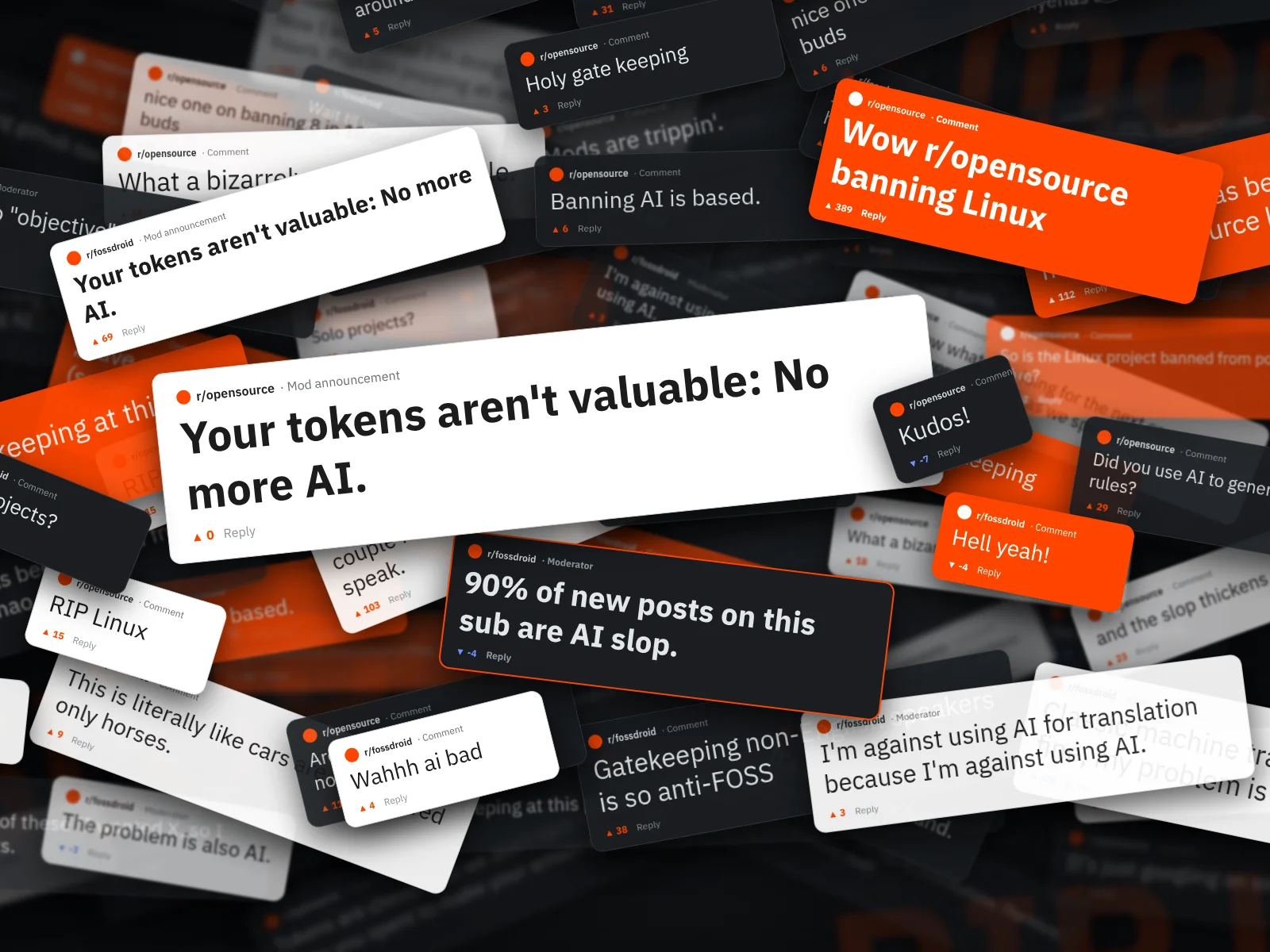
On Reddit, r/opensource is something like the corner pub of the open source world, the biggest community on the topic on the platform. Over the weekend, lead mod Wolvereness announced new rules there. The announcement is titled “Your tokens aren’t valuable: No more AI.” and slams the door on AI-assisted projects. The reasoning fits into one sentence: AI as it exists today is incongruent with this open source community.
Shortly afterwards, r/fossdroid followed suit, the go-to place for free Android apps. Its moderation copied the rules word for word into its own announcement, only the name of the subreddit is different. AI was never allowed there anyway, it says. In the comments, the moderation doubles down: nine out of ten new posts are AI slop, and everything gets sorted out by hand.
What the new rules demand
The announcement on r/opensource goes far beyond AI. A project has to be at least a year old and actively maintained, have multiple contributors, and point to an existing community. School projects and software built for AI, such as MCP servers, are out. Anyone who posts needs a Reddit account that is at least a year old and has significant activity. And if you don’t speak English, you are told to find a different community.
The core fits into one sentence: “If it’s obvious you’re using AI in your project, we don’t want it.” It is followed by the side swipe that gave the post its title: “Tokens are cheap, and we don’t care how many you spent to make your amazing project.” Anyone who posts AI content or begs for an exception via modmail is banned for good. Only officially incorporated nonprofit organizations are exempt from the minimum requirements.
On r/fossdroid, the language rule has since been struck through. Instead, the post now says it’s not about language or origin but about AI alone. Classic machine translation is allowed, translation via a language model is not. Whether DeepL or Google Translate still count as classic is anyone’s guess. Both have relied on neural networks for years, and Reddit now translates posts on its own.
How the rules came about is described on the blog of Dan Brown, the developer of BookStack and, until recently, one of the moderators of r/opensource. According to Brown, the rules came from Wolvereness alone, with nothing agreed with the rest of the team. Brown considers the AI rule unenforceable and the language rule hurtful. Brown has since stepped back as a moderator.
Linus Torvalds sees it very differently
The timing is delicate. The Linux kernel is currently going the opposite way. At the Maintainers Summit in Prague on October 8, a majority was in favor of dropping (in German) the “Assisted-by” tag for AI-assisted patches again. Only about ten percent of the 18,533 commits for Linux 7.3 up to -rc7 carry it, yet according to Sasha Levin, AI is used far more often. Developers are supposed to describe their use of AI in the cover letter from now on.
Linus Torvalds himself considers rules along the lines of “don’t use AI for X” idiotic and instead expects developers to understand what they are doing. On October 13, he submitted a series of ten patches that, according to it-daily (in German), he developed with Claude Code. Reviewers promptly found a race condition in them. So the kernel developers use AI quite openly, just with review.
No wonder “Wow r/opensource banning Linux” is among the top-voted comments under the announcement. Asked in all seriousness how the kernel would fare, Wolvereness replied that it would probably be allowed “on the subjective line.” In other words, AI is banned, unless the mods decide to look the other way. Wolvereness admits elsewhere that there is no objective standard.
What the community says
The backlash is fierce. The announcement sits at zero points, the top comment at more than 1,400: “This is orthogonal to open source.” Whether software is free is decided by its license, not by the tool. Another user has maintained a package with more than 300 stars on GitHub for nine years, entirely without AI. It gets thrown out anyway: only one maintainer.
The language rule draws at least as much anger, and many simply call it xenophobic. A user from Japan deliberately writes by hand, in shaky English, that translation services are needed for reading too, just to understand everyone else. And critics read the exemption for incorporated organizations as meaning that large projects may use AI, while individual developers may not.
There is support, too. Many welcome the end of the endless “I got tired of X so I built Y” posts, and some are glad that someone is finally cracking down. One commenter on r/fossdroid argues that prompted-together apps will never get the care developers give their own projects. Others counter that plenty of hand-written FOSS projects quietly die as well.
The opportunity: speed for projects without new blood
I can understand both sides. On the one hand, using language models in software development offers huge opportunities. It is simply incredibly fast, and yes, the code that comes out is often very usable. By the way, “Tokens are cheap” is only partly true: a retired software developer in the thread does the math and pays 200 dollars a month in AI subscriptions for an open source project.
Especially for projects where volunteer developers aren’t exactly lining up, this is a huge opportunity. On r/fossdroid, someone cites their own app ShizuCallRecorder as an example: 2,000 stars on GitHub, more than 103,000 downloads, but only two pull requests with code from outside, both created with AI help. How is a project like that supposed to reach three contributors? A blanket ban hits exactly these people.
More holes found, fewer new ones built in
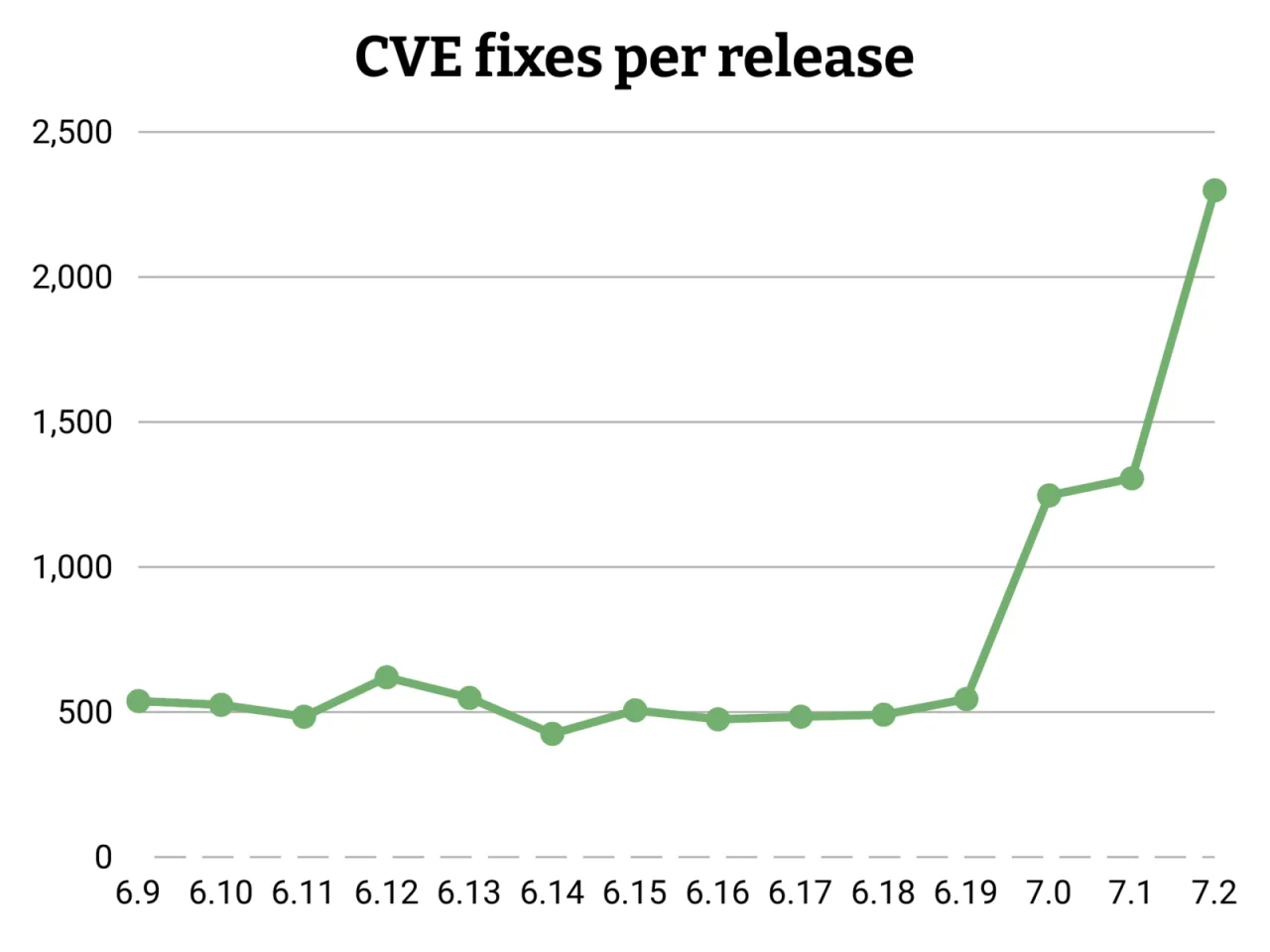
What AI can do for security is shown by two graphs from Greg Kroah-Hartman’s repository on kernel development. Up to Linux 6.19, each release consistently collected about 500 fixes for CVE vulnerabilities. With 7.0, the number jumps to more than 1,200, and with 7.2 to about 2,300. It’s hardly a coincidence that this happens right when AI tools for development and code analysis are picking up speed.
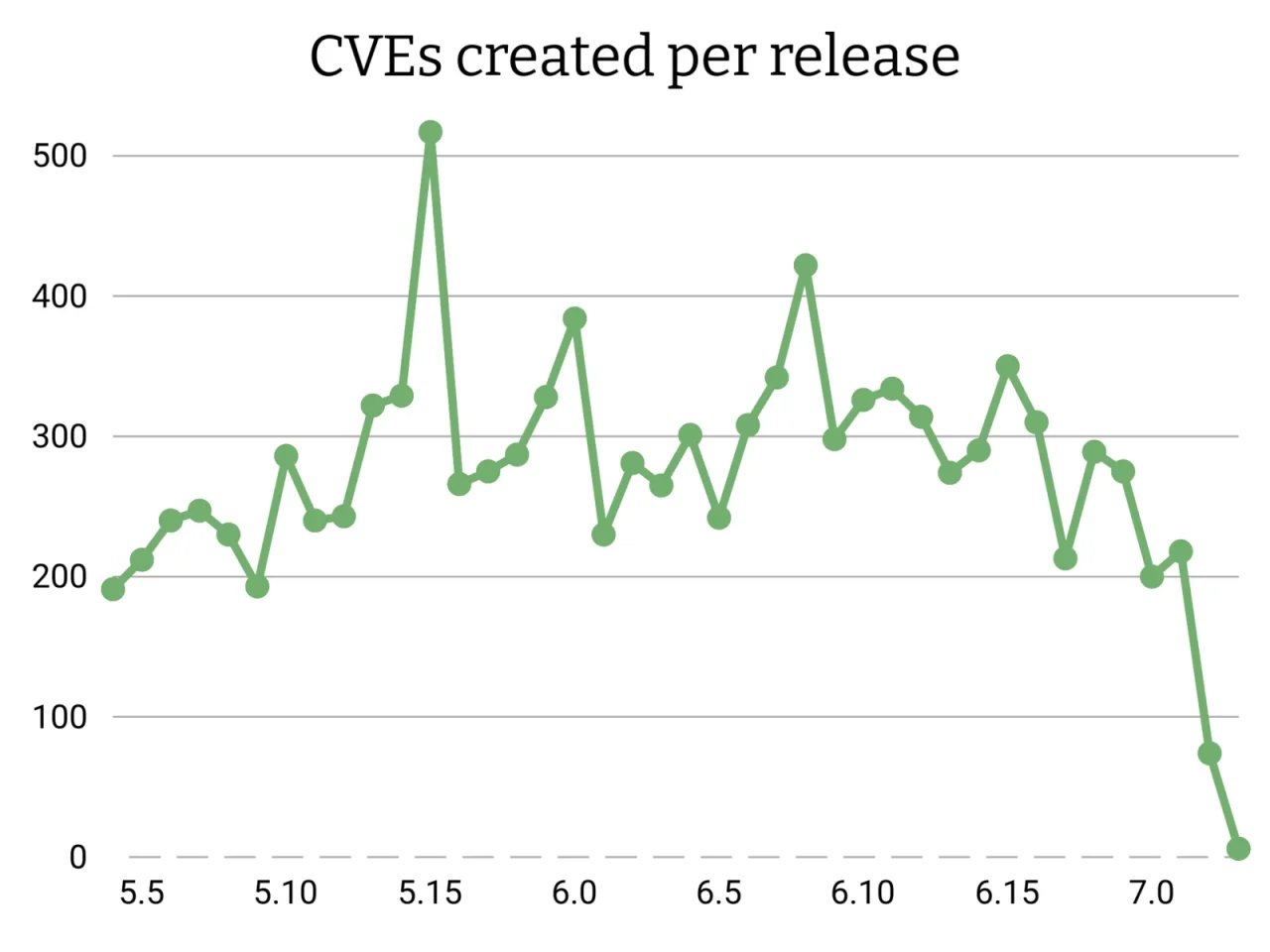
The second graph counts CVEs by the kernel release in which they were introduced. Since Linux 6.15 the curve has been pointing down, and for the most recent releases it is close to zero. In other words, more and more old holes are being uncovered, while new code brings fewer new ones. Sure, the far right end should be taken with a grain of salt: bugs in fresh code are often only found years later.
To me, that’s still the strongest argument against a blanket ban. A language model that reads existing code and tracks down bugs in it makes free software more secure, not less. Torvalds says he also uses AI to understand patches that are hard to follow. What matters is that in the end a human reviews the fix and takes responsibility for it. That applies to the kernel just as much as to the little Android app.
The flip side: somebody has to read the code
On the other hand, I can understand the mods too. Somebody has to look through the AI code. Passing any code into a project without review somehow goes against the whole idea of open source and security. The point of free software is precisely that anyone can look inside, and that someone actually does. Code that not even its own author has read turns this principle upside down.
If software becomes a black box again, you might as well go back to closed source. Throwing a project together overnight with a language model and then dumping the review on moderators, package maintainers, or project maintainers isn’t exactly good manners. The work doesn’t disappear. It just lands on other people’s desks, and most of them do it as volunteers, too.
An AI opponent on r/fossdroid gets to the heart of it, actually as an argument against the tool comparison: even Torvalds demands that AI output be reviewed, while nobody has to check a compiler. Someone else compares AI to a not-too-bright junior developer. You can ship their work without looking at it, or you can review it thoroughly and steer it until it holds up. For me, the line runs exactly between those two paths.
Responsibility instead of a ban
In my opinion, the kernel gets it more right than r/opensource. Anyone there may use a language model, but a human is responsible for every contribution and has to sign it off personally with Signed-off-by. In other words, it isn’t the tool that decides, but whether someone has understood their code. The fact that reviewers found a race condition in Torvalds’ patches shows exactly why review has to stay.
Sure, a subreddit isn’t a kernel, and the flood of junk projects, ads, and bot accounts is real. But good suggestions can be found in the threads themselves: anyone presenting a project should provide a demo, working installation steps, and a short explanation, or the post gets removed. That takes seconds to check, and junk stands out, no matter whether it comes from a human or a machine. What do you think? Btw: the header image? AI-generated, of course 😉



Leave a Reply