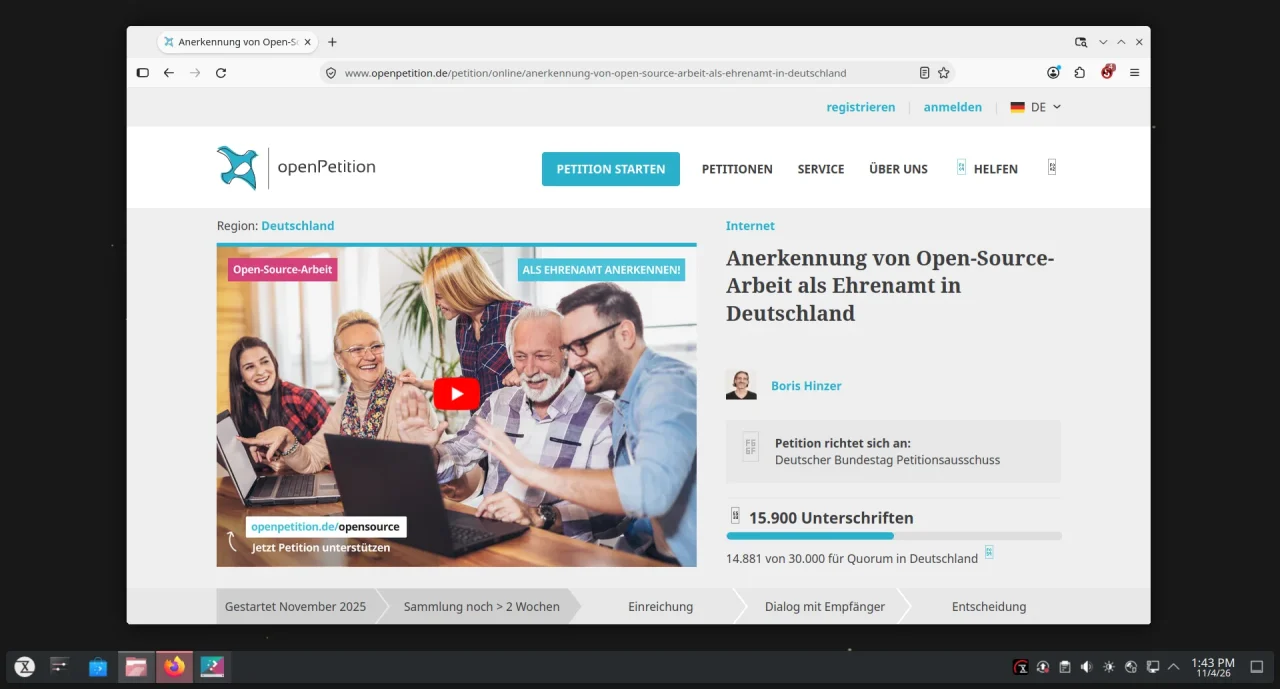
If you write, maintain or translate software for everyone in Germany, the law treats it as a hobby. For tax and funding purposes, work on open source projects doesn’t count as “Ehrenamt”, the formal status of volunteer work, unlike coaching at a sports club, youth work or the rescue services. The petition “Recognition of open source work as volunteering in Germany” wants to change that, and I’ve just signed it.
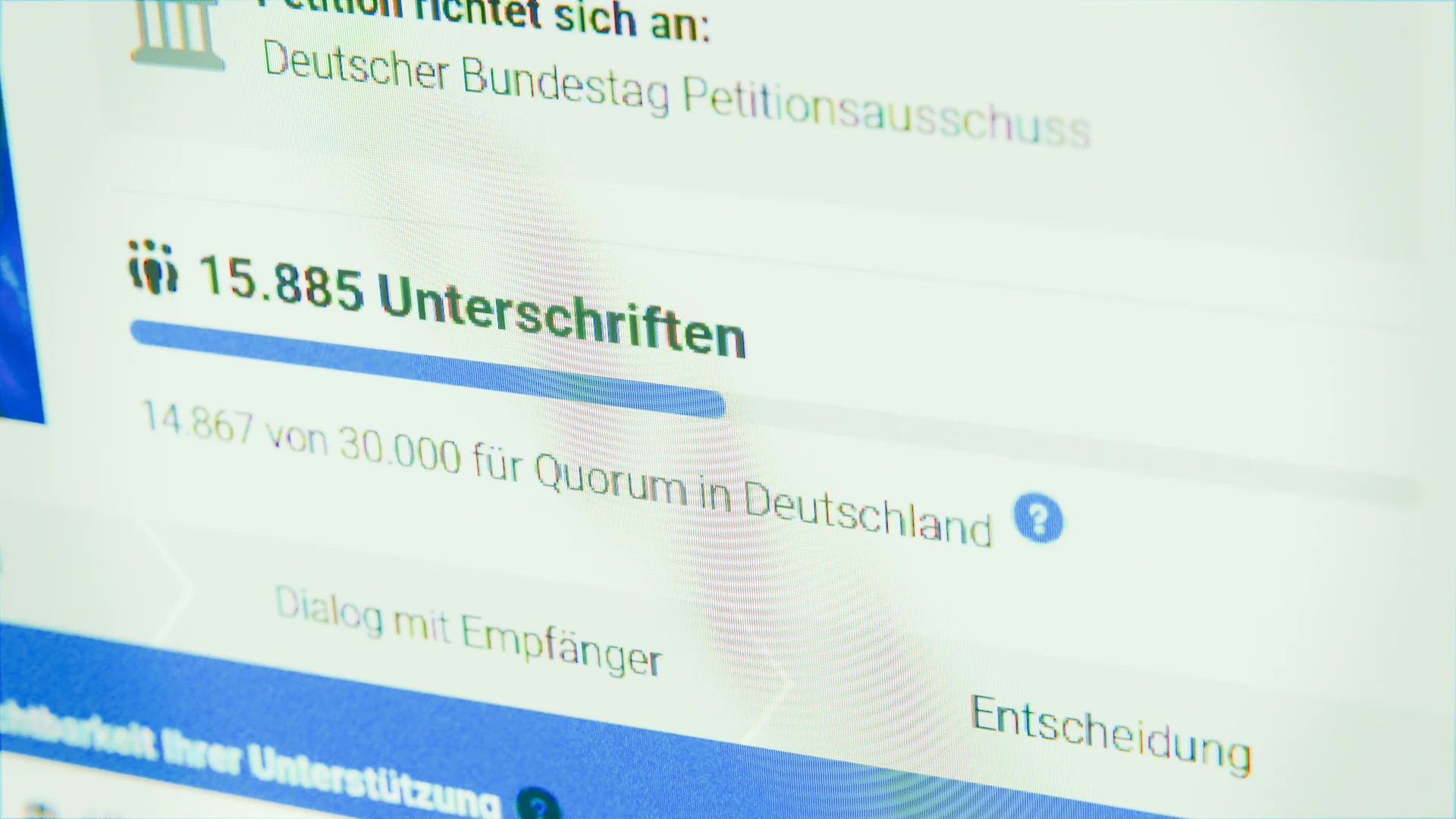
Boris Hinzer from Erkelenz started it in November 2025, and it’s addressed to the petitions committee of the Bundestag. Today the counter shows 15,884 signatures, 14,866 of which count toward the quorum in Germany. It takes 30,000. In other words, roughly half is still missing, and time is running out: the petition closes on November 23, 2026, in just under three weeks.
What the petition calls for
The demand is quickly explained: open source work should be recognized as volunteering for the common good, on equal footing with club work, youth work or the rescue services. It starts from a contradiction. Even the German government’s coalition agreement names open source as a building block for digital sovereignty. Yet the people who build, maintain and document this software in their spare time get nothing for it. The cooperative WECHANGE put it in a nutshell in its interview with Boris:
The volunteers who build it every day don’t even legally count as volunteers.
WECHANGE, interview with Boris Hinzer (translated)
The petition gives six reasons. First, open source demonstrably serves the common good: internet protocols, security libraries, health IT and education technology rest to a large extent on voluntary contributions. Second, most of the development, maintenance and documentation happens unpaid in people’s free time, much like the work in a non-profit association, just digital. Third, public authorities, schools and companies all depend on it.
Vulnerabilities like Heartbleed and Log4Shell showed just how much: millions of users benefit, while often only a handful of volunteers carry the responsibility. Fourth, recognition would create legal clarity. Fifth, volunteers do work that companies would otherwise have to buy at high hourly rates. And sixth, other countries already support free software with tax breaks and dedicated programs, so Germany risks falling behind.
Given enough eyeballs, all bugs are shallow.
Eric S. Raymond, The Cathedral and the Bazaar
With this line, Eric S. Raymond explained in the late nineties why open code should be more secure: if enough people look at it, every bug gets spotted. Heartbleed showed the catch, because the flaw sat unnoticed in OpenSSL for about two years. Randall Munroe immortalized this in the xkcd comic Dependency: all of modern digital infrastructure balances on one tiny block kept alive for years by one person in Nebraska, without much thanks.
The fourth point is the most concrete. With recognition, projects could pay tax-free expense allowances, just like sports clubs do for their coaches and volunteers. Non-profit projects would find it easier to get charitable status under German tax law. Contributors would be better protected against liability, similar to the board members of registered associations. And projects could reimburse costs and issue donation receipts on solid legal ground.
Why Boris started the petition
Boris runs a web agency in Mönchengladbach and has been active in the TYPO3 community for about 20 years, since 2023 as volunteer vice president of the TYPO3 Association. In a long interview with WECHANGE (in German), he explains that he twice asked a public radio station to mention open source people on Germany’s Volunteer Day on December 5. He never got a reply.
So he started a petition instead. He sums up his core argument in a line I like a lot: open source doesn’t live off “read-only”, it lives off taking part. Free software runs in ticket machines, game consoles and behind every streaming service, mostly without anyone noticing. The big tech companies make a fortune with it, yet contribute comparatively little to its development and funding.
If you’d rather listen than read, Linux Guides explains in a video (in German) what the petition is about and why open source needs your help:
More than just code
When people think of open source, they picture developers reviewing pull requests late at night. But a whole landscape of initiatives has grown up around it that brings free software to people. DI.DAY, launched at 39C3 by the Chaos Computer Club, author Marc-Uwe Kling and many others, invites you to swap one big tech service for a free alternative on the first Sunday of every month.
Ready-made “switching recipes” help with the move, from Firefox instead of Chrome and OpenStreetMap instead of Google Maps all the way to Linux instead of Windows. At repair cafés, volunteers don’t just fix toasters and bikes. Since Windows 10 reached its end of support, many also install Linux as part of the End of 10 campaign on computers that would otherwise have ended up at the recycling center. That saves money, e-waste and quite a few nerves.
Then there are coding clubs like CoderDojo or Germany’s Jugend hackt, where kids and teenagers use free tools to write their first programs, build robots or tinker with games. And there are courses for seniors, where volunteers patiently explain how to start a video call with the grandkids, set up a smartphone or spot a phishing email. In Germany, networks like Digital-Kompass support such offers. Without these people, many would simply be left behind by digitalization.
The odd part: helping out at a repair café can often already count as volunteering at a registered non-profit association today. The people who maintain the Linux that ends up on those old computers, or who translate the learning app for the coding club, do their work as a private pastime in the eyes of the law. Yet one depends directly on the other: without the software, there’d be nothing to install.
What I know from my own articles
I run into this topic here on the blog all the time. Just in October, I wrote about Javad Rahmatzadeh’s call for help. He reviews the extensions on extensions.gnome.org, often 4 to 10 hours a day and unpaid, while monthly donations are close to zero. Without his work, there’d be no reviewed GNOME extensions, and by his own account Javad is close to burning out.
It’s a similar story with DDNSS.de: Robert Niedziela has run the free DynDNS service since 2013, countless home servers rely on it, and now he’s looking for a successor. Or take the SELFHTML wiki, where generations of German web developers learned HTML. It had to go offline because of the PHP2Shell vulnerabilities until the team moved it to a new server, jumping 19 MediaWiki versions in four days.
When I launched PlanetFOSS, I also noticed how many of its sources come from people who write their articles in their free time. That’s why blogs can now add a link to their donation page there. And to be honest, I know that side myself: before this blog existed, I wrote around 38,000 posts as “Chrissss” in the forum of ubuntuusers.de, the big German Ubuntu community, and maintained wiki articles.
My take
Sure, there’s a catch, and critics in the petition’s debate point it out too: a large share of open source contributions comes from paid developers or freelancers. Without a clear line, a volunteer allowance could turn into a tax loophole. I agree, and drawing that line won’t be easy. But in my view, that’s a job for the lawmakers, not a reason to reject the recognition altogether.
Sports clubs manage the distinction just fine, after all: the pro coach gets a salary, the youth coach on Saturday morning gets the volunteer allowance. Why shouldn’t that work for a maintainer who patches security holes in a library after work? The petition doesn’t ask the state to pay for every line of code. It asks for the same rules that have long applied to other kinds of volunteering.
Sign and share the petition
So there are about 15,000 signatures from Germany still missing by November 23. That sounds like a lot, but it’s doable: if everyone who has signed convinces just two more people, the quorum is reached. Please tell people who have nothing to do with Linux, too. They use the software this is all about every single day anyway.
// Sign now
Sign the petition on openPetition, the form takes about a minute. Then share the link on Mastodon, Bluesky or LinkedIn, in your family chat or your club’s group. The petition page is also available in German, French and Spanish, so you can pass it on to friends in other countries too. Every signature brings the quorum a little closer.
If you don’t live in Germany, you can still sign and share it, even though only signatures from Germany count toward the quorum. Anyone who wants to promote it at their club, company or university can download a tear-off flyer with a QR code as a PDF from the petition page and put it up. Have you signed yet, and do you know other initiatives that wouldn’t exist without volunteers?
Leave a Reply